
What is an evidence-graded buyer persona?
 Clwyd Probert: Sep 30, 2026, 8:25:00 PM
An evidence-graded buyer persona is a buyer persona in which every claim carries a label saying where it came from: first-party evidence (the...
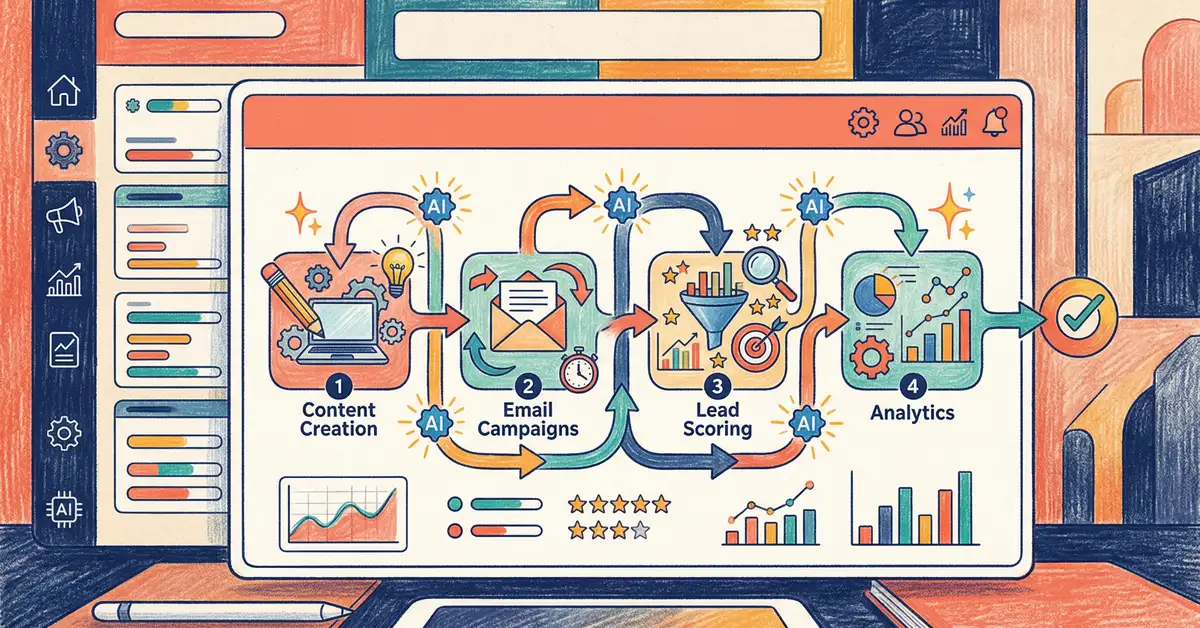
AI marketing automation uses artificial intelligence to handle repetitive marketing tasks — content creation AI content strategy framework, lead scoring lead scoring model template, email personalization, campaign reporting marketing reporting template, and workflow orchestration — so lean teams produce more without hiring more. Marketing automation returns $5.44 in benefits for every $1 spent over three years, on average, according to Nucleus Research. For marketing leaders managing a growing tool stack and shrinking budgets, automation isn't optional — it's the difference between competing and falling behind.
Key Takeaway
AI marketing automation goes beyond scheduling emails. The strongest teams use it to connect disconnected tools, score leads and produce more content without adding headcount, then put the time they get back into strategy, competitive analysis and creative work that AI cannot replicate.
$5.44
Return per $1 Spent
Marketing automation, over three years
88%
Organizations Using AI
Regularly, in at least one business function
Sources: Nucleus Research 2021, McKinsey State of AI 2025
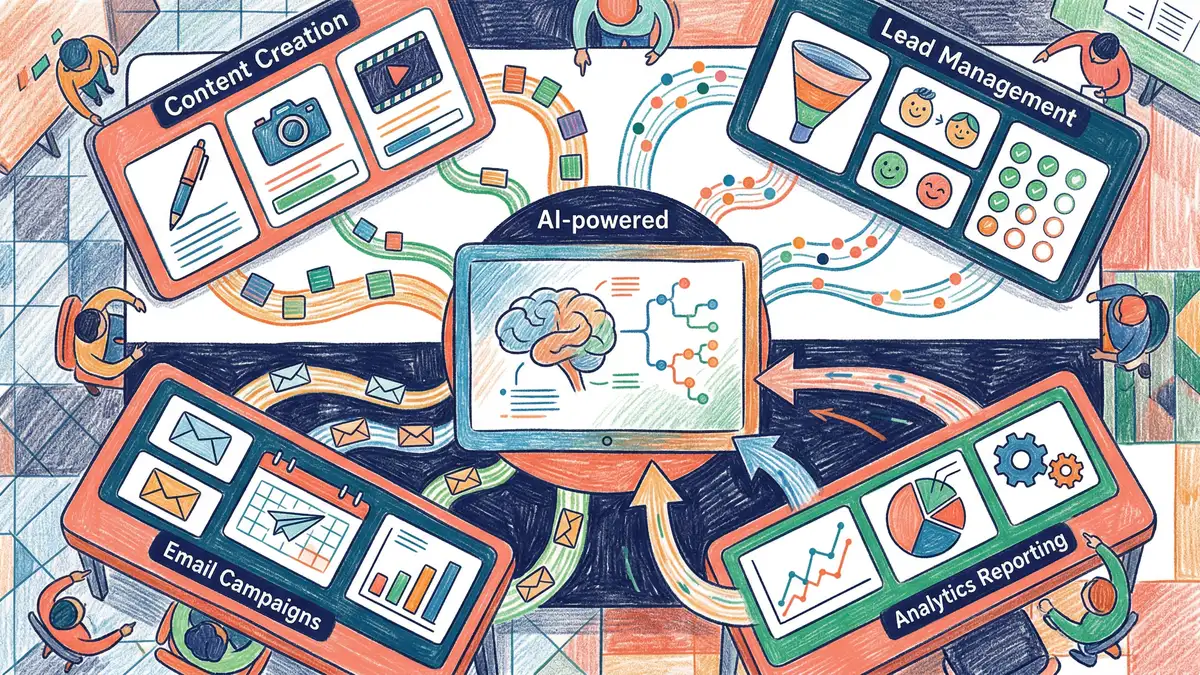
AI marketing automation combines machine learning, natural language processing, and predictive analytics with traditional rule-based marketing workflows. Traditional marketing automation follows if-then logic — if a contact opens an email, then send a follow-up three days later. AI marketing automation analyzes patterns across thousands of interactions to decide which email to send, when to send it, and what subject line will resonate with each individual contact.
The AI-in-marketing market was worth about $47 billion in 2025 and is projected to pass $107 billion by 2028, according to Statista's AI in marketing data. That growth reflects a shift from experimental adoption to operational necessity. In McKinsey's 2025 State of AI survey, 88% of respondents said their organizations regularly use AI in at least one business function, up from 78% a year earlier.
Traditional Automation
Rule-based, linear workflows. Requires manual setup for every scenario. Follows fixed sequences regardless of individual behavior. Effective for simple, predictable processes but struggles with personalization at scale.
AI-Powered Automation
Learns from data patterns, adapts in real-time, and predicts outcomes. Optimizes timing, content, and channel selection per contact. Handles complexity that would require hundreds of manual rules. Improves over time as more data accumulates.
For small teams, this distinction matters practically. A three-person marketing team managing a handful of tools cannot build the hundreds of branching rules needed for genuine personalization. AI handles that complexity, enabling lean teams to execute campaigns that previously required a larger team of specialists.
AI marketing automation doesn't improve one thing marginally — it transforms seven core operational areas simultaneously. Each area generates measurable ROI independently, but the compounding effect of automating multiple functions creates the real competitive advantage for resource-constrained small teams.
Content production represents the largest time drain for most small marketing teams. Manual content creation takes research, writing, editing and formatting for every piece. AI-assisted content creation speeds up production and cuts the cost of each piece, as Salesforce's marketing AI overview describes.
Marketing Mary takes this further for articles. It researches first, then drafts, adds images and runs a quality check, and a named person approves before it publishes to HubSpot. Then it adds internal links between your articles and checks the live page. Read more about how an automated content creation pipeline works.
Lead scoring pays for itself when it is done well: companies that implement lead scoring achieve 138% ROI on lead generation compared with 78% for those without it, according to Landbase's roundup of lead scoring statistics. AI scoring builds on this by learning from your own conversion data.
The difference comes down to signal processing. Manual scoring relies on firmographic data — company size, industry, job title. AI scoring analyzes hundreds of behavioral signals simultaneously: page visit patterns, email engagement sequences, content download paths, and timing patterns that humans simply cannot track across thousands of contacts.
McKinsey research shows personalization most often drives a 10 to 15 percent revenue lift. Yet most small teams lack the resources to manually personalize content across segments, channels, and touchpoints. AI personalization engines analyze individual behavior patterns to deliver tailored content, offers, and messaging without building each version by hand.
For a B2B SaaS company with 5,000 contacts across three buyer personas, manual personalization across email, web, and social would require creating and managing 45+ content variations. AI generates and serves these variations dynamically, maintaining relevance without the content team building each variant manually.
For small teams, even modest reporting automation — automated UTM attribution, cross-channel performance dashboards, anomaly detection — reclaims hours every week that analysts currently spend pulling data from disparate platforms and building manual reports.
AI-powered analytics goes beyond automation: it identifies patterns human analysts miss. When a campaign's click-through rate drops 15% on Tuesdays but only for mobile users in the finance segment, AI surfaces that insight automatically. Marketing teams can then act on the signal rather than spending hours discovering it.
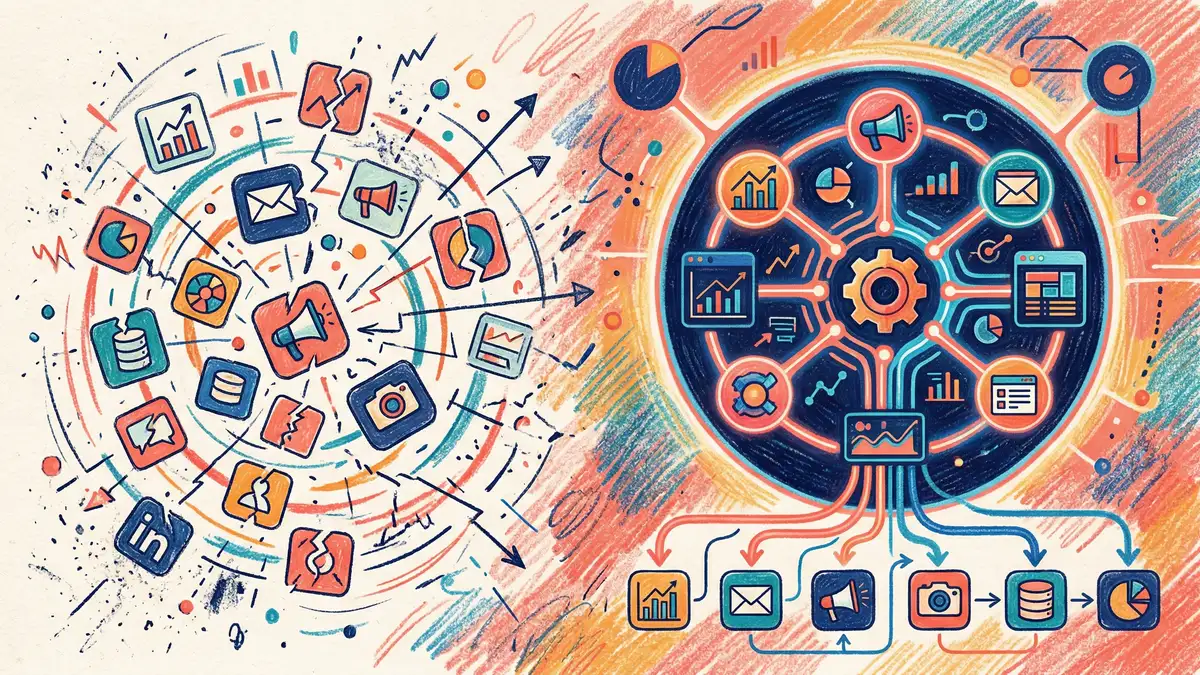
Small marketing teams often run more tools than they need once you count subscriptions, integration platforms (Zapier, Make), onboarding and maintenance. This "tool sprawl how to build a MarTech stack" creates disconnected data, broken attribution, and hours lost every week to manual data reconciliation between platforms.
AI-powered marketing workflow automation can consolidate these disconnected stacks down to a few core platforms, which cuts subscription and maintenance costs. More importantly, unified data enables AI applications that are impossible in disconnected environments: cross-channel attribution, predictive lead scoring, and automated content personalization all require consolidated data to function effectively.
Traditional buyer persona development takes weeks of agency research. AI-powered persona tools reduce this to days rather than weeks, and the better ones show where each claim came from, so personas can be checked and updated as conditions shift rather than going stale in a PDF.
Marketing Mary builds buyer personas from a company's own website and labels every claim with where it came from. You can also talk to each persona to test messaging and likely objections before you commit budget. Our guide to creating a buyer persona covers the method.
AI-driven SEO tools speed up the research behind optimization. The speed advantage comes from AI's ability to process competitor content, search intent patterns, and SERP features simultaneously — identifying gaps and opportunities that manual analysis takes weeks to uncover.
For small teams, AI SEO automation handles keyword research, content gap analysis, technical audits, and performance monitoring as a continuous process rather than periodic project. An AI marketing agent orchestrates these functions end-to-end, from identifying which topics to target through to publishing optimized content and monitoring rankings — what previously required an SEO specialist, content writer, and web developer working in coordination.
The Bottom Line
Automation in one area frees time for the next, so plan the seven areas as one program rather than seven separate projects.
The AI marketing tool landscape includes hundreds of options across enterprise platforms, specialist point solutions, and emerging AI-native tools. For small and mid-sized teams, the choice isn't which tool is "best" — it's which combination delivers the most capability per dollar while minimizing integration complexity.

| Platform | Monthly Cost | Best For | Key Strength | Small-Team Limitation |
|---|---|---|---|---|
| HubSpot Breeze AI | $800–$3,600+ (Marketing Hub Pro to Enterprise) | All-in-one CRM + marketing | Native CRM integration | Expensive for full AI features; slow iteration |
| Salesforce Einstein | $125/user (Agentforce add-on for Sales or Service) | Enterprise CRM-centric teams | Predictive analytics depth | Complex setup; requires dedicated admin |
| Jasper AI | $59–$69/seat | High-volume content creation | Fast content templates | Generic output; no CMS publishing or SEO pipeline |
| Adobe Marketo | Pricing on request | Enterprise demand gen | Campaign orchestration depth | Implementation is a major project; overkill for most small teams |
Sources: Vendor pricing pages (March 2026), G2 Marketing Automation Category 2026
The critical gap in this landscape: most tools handle one function well — content generation (Jasper), CRM workflows (HubSpot), or predictive analytics (Salesforce).
Successful AI marketing automation implementation requires a phased approach. Teams that attempt to automate everything simultaneously typically fail — not from technology issues, but from change management overload. This framework separates readiness, pilot, change management, and scaling into distinct phases with clear success criteria.
Readiness Assessment (Weeks 1–2)
Audit your current tool stack, quantify costs and time waste, assess data quality across CRM and marketing platforms, and identify 2–3 highest-impact use cases. Apply the 40-30-20-10 budget rule: 40% integration/data, 30% software, 20% training/change management, 10% ongoing operations.
Pilot Design and Execution (Weeks 3–6)
Select the highest-impact, lowest-complexity use case from your readiness assessment — typically content creation, lead scoring, or email personalization. Define specific KPIs: "Generate 40% more qualified content with same team within six weeks" rather than vague "improve content quality." Document successes, failures, and integration challenges throughout.
Change Management and Training (Weeks 7–8)
Address the biggest implementation risk: team resistance. Position AI as augmentation ("AI handles data processing, freeing you for strategy and creative work"), not replacement. Share concrete pilot results with specific numbers. Map redesigned workflows documenting which manual tasks are now automated versus which remain human-led. Dedicate 20–25% of project resources to this phase.
Measurement and Scaling (Weeks 9+)
Expand successful pilots incrementally — one department or function at a time. Track three-tier ROI: realized ROI (cost savings, revenue — the slowest to show), trending ROI (efficiency improvements — usually visible first), and capability ROI (skills, infrastructure — ongoing). Budget for ongoing AI system maintenance and retraining, not just the launch.
See how Marketing Mary takes an article from research to an approved, published post.
See how articles workThe business case for AI marketing automation rests on three pillars: direct cost reduction, revenue acceleration, and time reallocation. Each pillar generates measurable returns independently, and the combined impact exceeds the sum of individual improvements.
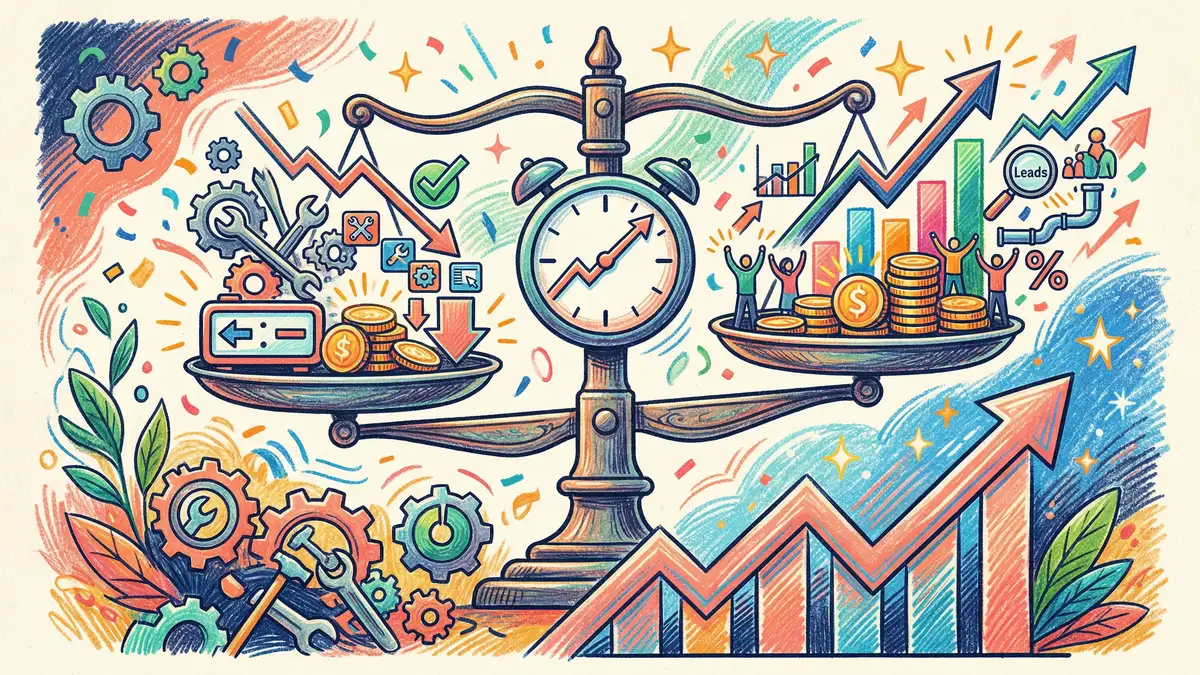
| ROI Category | Without AI | With AI Automation | What changes |
|---|---|---|---|
| Tool stack | Many subscriptions plus integrations to maintain | A few core platforms | Fewer tools to pay for and maintain |
| Content production | Research, writing, editing and formatting by hand | AI-assisted drafting with human editing | Faster production per piece |
| Time reclaimed | Hours each week on routine tasks | Redirected to strategy | Depends on your team's hourly cost |
| Lead scoring accuracy | Rules-based scoring | Predictive scoring trained on your data | Better-prioritized sales follow-up |
What changes in each area, not measured results. Sources: Nucleus Research 2021, McKinsey 2024
Adding marketing headcount is expensive, so automation that takes routine work off a small team helps it compete with better-resourced competitors.
AI marketing automation implementations fail at a surprisingly high rate — not because the technology doesn't work, but because of predictable organizational and strategic mistakes. Understanding these pitfalls before implementation saves months of wasted effort and prevents the "AI scepticism" that often follows a failed pilot.
The Biggest Mistake: Automating Judgment-Heavy Functions
Common mistake: Fully automating brand messaging, creative direction, or campaign strategy — functions that require human judgment, intuition, and strategic context. Content fully generated by AI without human review frequently displays generic quality, tone inconsistency, or brand misalignment.
The reality: The highest-value implementations reserve automation for execution and optimization while maintaining human leadership over strategy and judgment. AI generates content variations; humans select which reflect brand voice. AI recommends lead prioritization; sales teams adjust based on account strategy.
| Pitfall | Impact | Prevention |
|---|---|---|
| Poor data quality | Lead scoring trained on corrupt data produces invalid predictions | Conduct data audit in Phase 1; clean critical fields before deployment |
| Inadequate change management | Teams resist adoption; technology underperforms potential | Dedicate 20–25% of budget to training and communication |
| Tool sprawl multiplication | Bolting AI tools onto existing stack increases complexity | Consolidate around unified platforms; integrate specialists selectively |
| Skipping the pilot | Organization-wide launches multiply risk and overwhelm teams | Start with one high-impact use case; validate value before scaling |
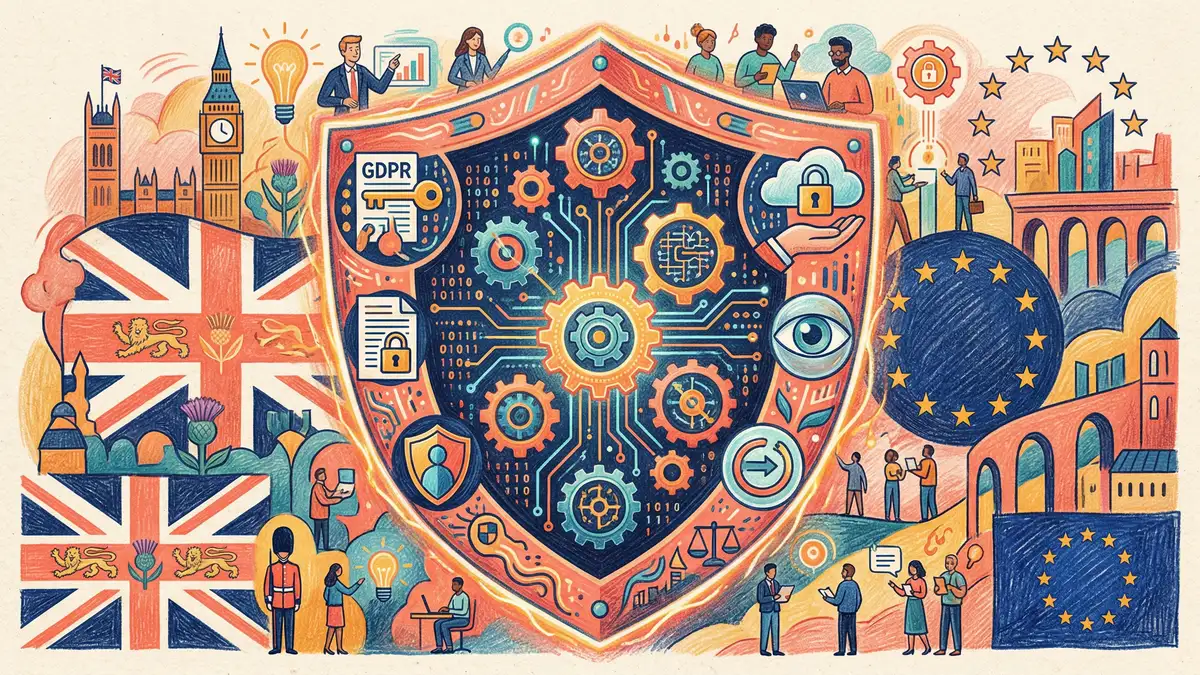
If you market to people in the UK or EU, three sets of rules shape how you can use AI marketing automation: UK GDPR as amended by the Data (Use and Access) Act 2025, the EU AI Act, and GDPR itself. If you have US contacts, US rules apply as well (see below). Knowing them tells you which AI uses are straightforward and which need extra safeguards.
The UK Data (Use and Access) Act 2025 (DUAA) received Royal Assent on June 19, 2025, and most of its data protection changes took effect on February 5, 2026. It created a new lawful basis, "recognised legitimate interests", but that list covers purposes such as crime prevention, public and national security, safeguarding, emergencies and helping other organizations with their public tasks, not marketing. Direct marketing is named in UK GDPR as a purpose that may be a legitimate interest, but the ICO says you must still carry out the three-part legitimate interests test, and legitimate interests can't be used where the email and text marketing rules (PECR) require consent. The Act also relaxed the restrictions on decisions made solely by automated means, as long as you have safeguards in place: telling people about the decision, letting them make representations, offering human intervention and letting them contest it. The restriction on using special category data in those decisions remains.
The EU AI Act entered into force on August 1, 2024, and applies in stages. Its strictest rules are for high-risk uses such as credit decisions, employment and biometric identification, which rarely cover standard marketing AI; after the EU's AI Omnibus amendment, those rules apply from December 2, 2027. Its transparency rules have applied since August 2, 2026: providers of generative AI must mark outputs as artificially generated in a machine-readable way, and deployers must disclose deepfakes and AI-generated text published to inform the public on matters of public interest, unless a person has reviewed it and someone holds editorial responsibility. Check how your tools handle this, and set a disclosure policy for any content those rules cover.
GDPR remains the foundational requirement. Machine learning models trained on personal data inherit privacy obligations. If you rely on legitimate interests for AI-driven personalization, document the assessment, and carry out a Data Protection Impact Assessment (DPIA) before any processing that is likely to result in a high risk to people's rights and freedoms.
In the US, there is no single federal privacy law. Section 5 of the FTC Act prohibits unfair or deceptive acts or practices, and the FTC has said there is "no AI exemption from the laws on the books", so claims about what your AI-powered product or campaign can do need to be accurate and supportable. State privacy laws apply too. California's CCPA, as amended by the CPRA, gives consumers the right to know, delete and correct the personal information a business holds about them, to opt out of its sale or sharing, and to limit the use of sensitive personal information; it also requires a contract with the service providers you disclose that information to. Virginia and Colorado are among the other states with their own comprehensive privacy laws.
This is general information, not legal advice: check how these rules apply to you with your own legal adviser.
Gartner predicts that by 2028, 60% of brands will use agentic AI to deliver streamlined one-to-one interactions — AI agents that span marketing, sales and support rather than working one channel at a time. Gartner's Emily Weiss calls this "the end of channel-based marketing as we know it."
For small teams, this future demands preparation now. Agentic AI requires stronger data governance, greater transparency in customer data usage, and tighter platform integration — capabilities that don't emerge overnight. Teams beginning data governance and compliance work today establish the foundation for adoption when agentic systems mature. Teams continuing with manual processes and disconnected tool stacks will struggle to adapt when the market shifts.
Forrester predicts that less than 15% of firms will turn on the agentic features in intelligent automation suites in 2026. This slow adoption by enterprises creates an opportunity for agile small teams using purpose-built AI-native platforms to outpace larger competitors still managing transformation from legacy architectures.
Costs vary widely. HubSpot's Marketing Hub, for example, runs from $800 a month for Professional (billed yearly, plus a $3,000 onboarding fee) to $3,600 a month for Enterprise (plus $7,000 onboarding), with Breeze AI features drawing on monthly HubSpot Credits. Setup and training on top depend on the partner and scope, so get them quoted before you commit.
No — and that's not the goal. AI marketing automation replaces tasks, not teams. It handles repetitive execution (data processing, email scheduling, report building, content formatting) while humans focus on strategy, creative direction, and relationship building. The aim is to augment your team, not to reduce headcount.
Trending ROI (efficiency improvements) usually shows first, during a focused pilot. Realized ROI (measurable cost savings and revenue impact) takes longer to appear. Organizations following the phased implementation framework — readiness assessment, pilot, change management, scaling — achieve positive ROI faster than those attempting organization-wide deployment from day one.
It can be, when implemented correctly. If your contacts are in the UK or EU, GDPR still requires a lawful basis for each use: legitimate interests needs a documented three-part test and can't replace consent where the email and text marketing rules require it. Since February 5, 2026, the UK's Data (Use and Access) Act has allowed solely automated decisions in a wider range of situations, provided you offer safeguards such as human intervention and a way to contest the decision. Carry out a Data Protection Impact Assessment where processing is likely to result in a high risk to people, and be open about automated processing. This is general information, not legal advice.
Traditional marketing automation follows fixed rules — "if contact opens email, then send follow-up." AI marketing automation analyzes patterns across thousands of interactions to predict which action, timing, and content will produce the best outcome for each individual contact. The difference matters practically: AI handles complexity that would require hundreds of manual rules, enabling personalization at scale without additional headcount.
See what Mary finds on your website.
Join the early-adopter list and be one of the first to try Mary on your own website.
Plans from Free to Enterprise · pricing to be confirmed
Clwyd Probert
Founder, Marketing Mary
Clwyd Probert is the founder of Marketing Mary, an evidence-first persona intelligence platform for B2B marketing, and CEO of Whitehat, a London-based SEO and inbound marketing agency and HubSpot Diamond Solutions Partner.
Sources: Nucleus Research Marketing Automation ROI 2021, McKinsey State of AI 2024, Statista, AI use in marketing, Gartner Agentic AI Predictions 2026, Salesforce Marketing AI Research, UK Data Use and Access Act 2025
HubSpot marketing automation setup guide integrating AI with your HubSpot portal
marketing ROI calculator Measure multi-channel campaign performance using attribution models Track automation performance with our free marketing dashboard template
See what Mary finds on your website.
Join the early-adopter list and be one of the first to try Mary on your own website.
Plans from Free to Enterprise · pricing to be confirmed
 Clwyd Probert: Sep 30, 2026, 8:25:00 PM
An evidence-graded buyer persona is a buyer persona in which every claim carries a label saying where it came from: first-party evidence (the...
 Clwyd Probert: Sep 9, 2026, 11:58:11 PM
Our own Search Console tells this story: impressions up 53% and clicks down 6% in the 28 days to September 6, 2026, compared with the 28 days before,...
 Clwyd Probert: Aug 25, 2026, 10:16:09 AM
You can find HubSpot's credit rates. You can find your monthly allowance. What you cannot easily find is the sentence that connects them — so most...
 Clwyd Probert : Mar 24, 2026, 9:30:00 PM
What separates a true AI marketing agent from a chatbot: the five capabilities that define real agents, and how a small marketing team can start with...
 Clwyd Probert : Mar 27, 2026, 8:00:00 AM
Compare nine AI marketing tools for 2026: pricing, data-privacy checks, and a framework for choosing without tool sprawl.
 Clwyd Probert : Apr 23, 2026, 9:00:00 AM
Master marketing operations with our 4-level maturity model and 12-month roadmap. Stack optimization framework, KPIs, and free templates for B2B...