
What is an evidence-graded buyer persona?
 Clwyd Probert: Sep 30, 2026, 8:25:00 PM
An evidence-graded buyer persona is a buyer persona in which every claim carries a label saying where it came from: first-party evidence (the...

Automated content creation is the use of software, usually AI, to take an article from a question to a published page: research, drafting, images and checks. Most of that work can be automated. The decision to publish shouldn't be. A named person should check the claims and approve each piece before it goes live.
That split matters more as the volume of AI writing grows. An Ahrefs analysis of 900,000 English-language pages first detected in April 2025 found that 74.2% contained some AI-generated content (measured with Ahrefs' own AI detector). Google's guidance on using generative AI content is blunt about what that means for publishers: "It is critical to manually factcheck and review all AI-generated content for accuracy and trustworthiness before publishing." Below: what each stage does, which steps are safe to hand to software, what an approval should check, and where Marketing Mary fits.
Key takeaway
Automate the work, not the judgment. Research, drafting, images, formatting and the mechanical checks are good candidates for automation. Deciding what's true, what the business is willing to promise and what goes out under its name stays with a person, and that person should be named.
An automated content pipeline is a fixed sequence of stages that turns a question into a published article, with each stage handing a defined output to the next. The order matters more than the tools. A sound pipeline does the same eight things, in the same order, every time:
Question and brief
Pick a question your buyers ask; note who it's for and what it must cover.
a person sets the directionResearch
Find and keep the sources before drafting. If the evidence is thin, record that.
automateDraft
Write against an approved brand identity: tone, audience, banned words, required disclaimers.
automateImages
Create images at the right sizes, each with a text description for screen readers.
automateQuality check
Check claims against sources, plus headings, structured data and brand rules; list what couldn't be checked.
automate, report to a personApproval
A named person reviews the article and the check, decides on anything flagged and signs off.
a person decidesPublish
Send the approved version to the CMS with its title, meta description and structured data.
automate, after approvalMonthly review
Decide what's working, what's out of date and what to write next.
a person decidesPeople own the question, the approval and the review. Everything between is work software can do well, as long as each stage leaves a record the approver can check. To plan the questions on a schedule, try our content calendar template.
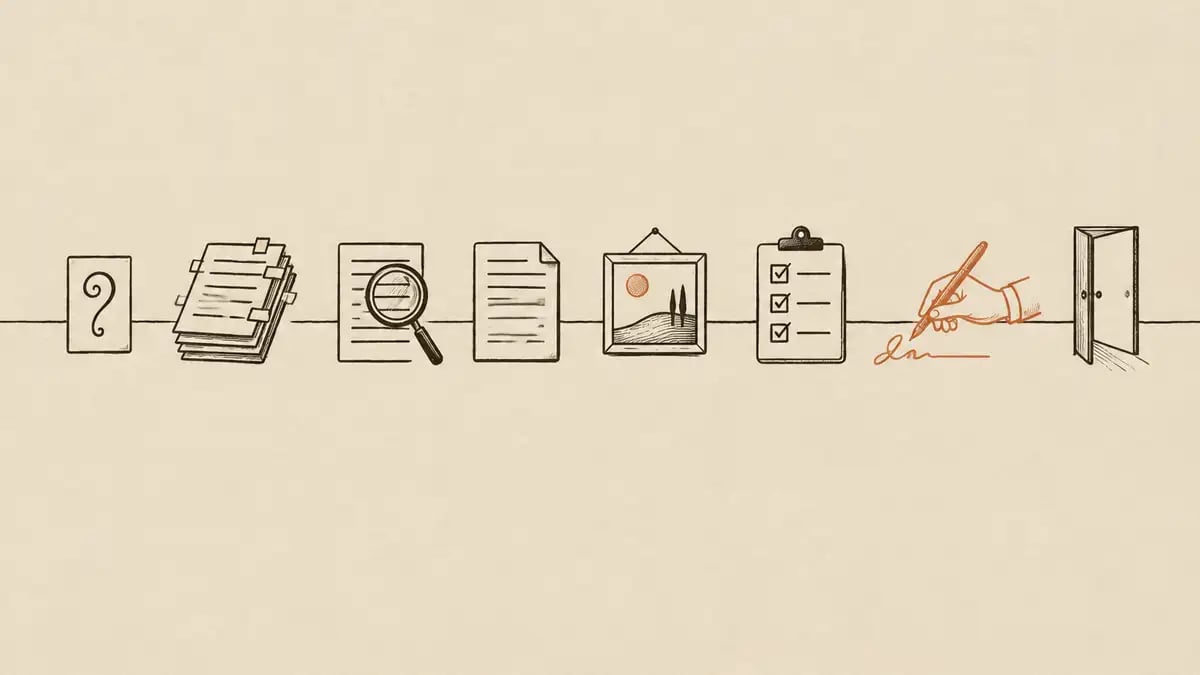
The stages of an automated content pipeline. Everything up to the checklist can be automated; the signature is a person.
A step is safe to automate when its output can be checked against something outside the model: a source, a rule, a size limit, a schema. A step needs a person when it involves judgment the business will be held to: what it claims, promises and publishes under its name.
| Step | Automate? | Why | What the person checks |
|---|---|---|---|
| Brief | Partly | Search data can suggest questions; you know which buyers matter | Buyers really ask it |
| Research | Yes | Finding and storing sources is repeatable | Sources are real, current and say what is claimed |
| Draft | Yes | Writing to a set brand identity is repeatable | Nothing stated more certainly than the evidence allows |
| Images | Yes | Sizes, formats and descriptions follow rules | No implied feature or result that isn't real |
| Quality check | Yes | Rule-based checks suit software | The report, including checks that couldn't run |
| Approval | No | Accountability can't be handed to a tool | The six-point checklist below |
| Publish | After approval | Moving an approved version is mechanical | What went live is what was approved |
| Review | Partly | Performance data can be pulled automatically | What to update, retire or write next |
Our recommendation for a business blog. Regulated industries may need more steps with a person.
The pattern: automate anything with a checkable output, and keep a person wherever the output is a decision. Courts have drawn the same line. Sanctioning two lawyers who filed ChatGPT-invented case citations, a federal judge in New York wrote in June 2023 that "there is nothing inherently improper about using a reliable artificial intelligence tool for assistance. But existing rules impose a gatekeeping role on attorneys to ensure the accuracy of their filings." Publishing has the same gatekeeper role; it just isn't written into court rules.
AI-written content needs a human check because language models produce fluent text whether or not it's true. NIST's Generative AI Profile (July 2024) calls this confabulation: "The production of confidently stated but erroneous or false content (known colloquially as 'hallucinations' or 'fabrications') by which users may be misled or deceived." It is one of 12 risks NIST lists. The figures below show how often it happens, and how rarely it gets checked.
55%
GPT-3.5 citations that were fabricated
18% for GPT-4, in a 2023 study of 636 citations (Scientific Reports)
17–33%
How often leading legal AI research tools hallucinated
Even though they retrieve from legal databases (Stanford, 2025)
27%
Organizations where employees review all gen-AI content before use
Of respondents whose organizations use gen AI (McKinsey, 2025)
60%+
AI search answers that misidentified a news source
Across 1,600 queries to eight AI search tools (Tow Center, 2025)
Sources: Walters and Wilder, Scientific Reports, 2023, Magesh et al., Journal of Empirical Legal Studies, 2025, McKinsey, The state of AI, Mar 2025, Tow Center for Digital Journalism, Mar 2025
Two points follow. Grounding a model in real documents helps but doesn't settle it: the tools in the Stanford study searched real legal databases and still hallucinated. And most organizations aren't checking: in McKinsey's survey, a similar share to the 27% said 20% or less of their gen-AI content is checked before use.
Research should come before the draft because a draft written first goes looking for evidence to fit it, and a model asked to support a sentence will happily supply a plausible source. When research comes first, the draft can only say what the sources say, and every claim already has somewhere to point.
The order also changes what happens when evidence is thin. The honest article says so: "we found little published research on this" is a useful finding. A draft-first process fills the gap with confident generalities, the kind of low-value page Google has been removing. After its March 2024 core update finished rolling out, Google said searchers would see "45% less low-quality, unoriginal content in search results." Four rules keep research in charge of the draft:

You stop AI content making things up by making every checkable claim traceable, and by keeping the model away from what it handles worst: quotations, citations and statistics. Three controls help most.
List every checkable claim in the article (each figure, date, name, quote, "first" or "only") with the source it rests on and a status. The table is what the approver reviews, so a claim without a row doesn't ship. Marketing Mary's quality check makes sure every claim that can be checked has its evidence listed.
| Claim | Source | Status |
|---|---|---|
| "55% of GPT-3.5 citations were fabricated" | Walters and Wilder, Scientific Reports, Sep 2023 | Checked against the paper |
| "Review all AI-generated content before publishing" | Google Search Central, generative AI guidance, updated Oct 1, 2026 | Quote copied from the page |
| "This approach will double your leads" | None | Removed: a promise with no evidence |
| "No other tool does this" | None | Removed: an absence claim nobody can prove |
Example rows from this article's own claims table, plus two that a reviewer would strike.
A model asked for a quote will often write one. Quotations should be copied from the stored source text and checked word for word. A real source isn't enough on its own: Walters and Wilder found that among ChatGPT citations pointing to real works, 43% (GPT-3.5) and 24% (GPT-4) had substantive errors.
Two kinds of sentence deserve a human decision every time: promises about future results ("this will double your leads") and claims that something doesn't exist ("no other tool does this"). Both are easy for a model to write and hard for anyone to prove. The FTC's substantiation policy expects advertisers to "have a reasonable basis for advertising claims before they are disseminated." Software can find these sentences; only a person can decide whether the business stands behind them.
Automating the work doesn't move the responsibility
In Moffatt v. Air Canada (Feb 2024), a Canadian tribunal held the airline responsible for what its website chatbot told a customer, calling the idea that the chatbot was "a separate legal entity" responsible for its own actions "a remarkable submission."
In Mata v. Avianca (June 2023), a New York federal judge imposed a $5,000 penalty on two lawyers and their firm for submitting non-existent cases generated by ChatGPT.
Since Oct 21, 2024, the FTC's fake reviews rule has covered reviews by someone who does not exist, "such as AI-generated fake reviews."
Whatever writes the words, the business that publishes them owns them.
Follow one article from question to approval
See how Marketing Mary researches, drafts, checks and then waits for a named person to approve, on real screens with sample data.
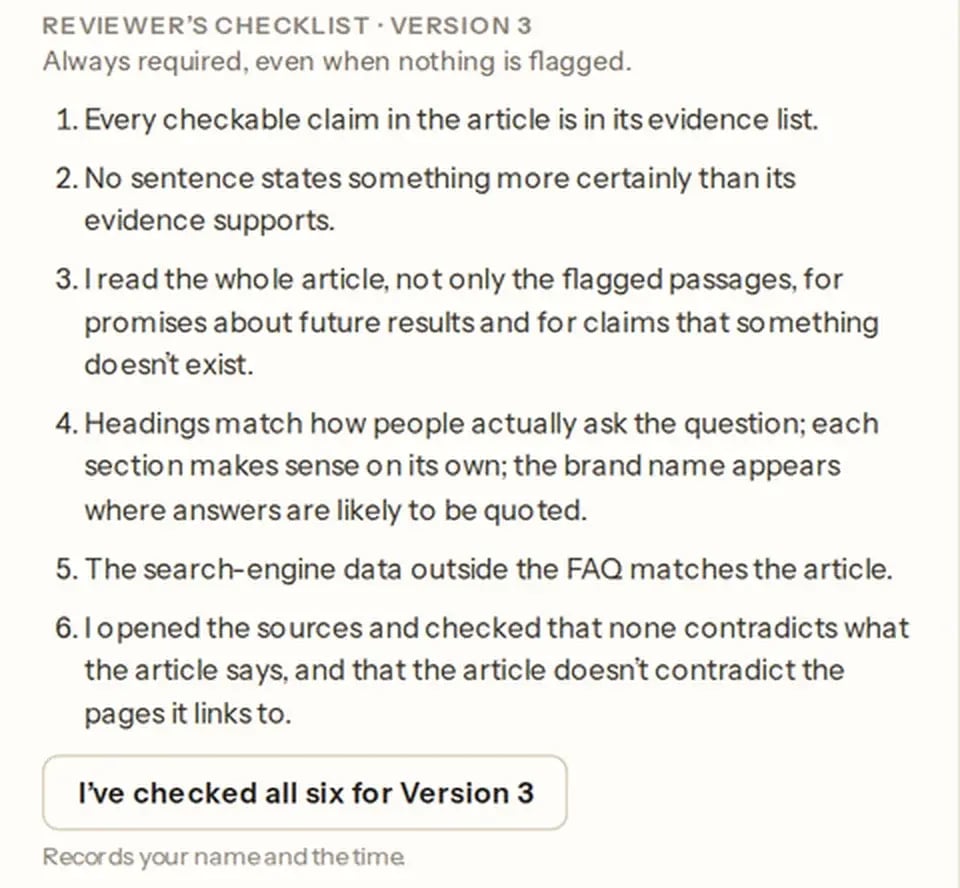
Marketing Mary's reviewer checklist. Real screen, sample data.
A human approval should check the claims, the certainty, the promises, the structure, the structured data and the sources, recorded against the exact version that will go live. A fixed checklist tells the approver what they're signing for. A general six-point version:
Point 5 is the easiest to skip, and Google is explicit about it. Its structured data guidelines say "Your structured data must be a true representation of the page content," and its generative AI guidance extends the review to metadata: titles, meta descriptions, structured data and image text descriptions all count as content a person should check.
Two more rules make approval mean something. Keep approval locked while any must-fix issue is open, so nobody signs over a known problem. And lock the approved article: any later change becomes a new version that is checked and approved again, so you always know which version was signed off.
No, not for being automated. Google's guidance since February 2023 is that "Appropriate use of AI or automation is not against our guidelines." What Google acts on is purpose and value: "Using automation—including AI—to generate content with the primary purpose of manipulating ranking in search results is a violation of our spam policies."
In March 2024 Google widened its scaled content abuse policy to cover "producing content at scale to boost search ranking — whether automation, humans or a combination are involved." Its people-first content guidance suggests disclosing AI use "when it would be reasonably expected." For a business blog the practical reading is: automate the production, publish only what a person has checked and would put their name to, and skip pages whose only job is to rank.
An article is more likely to be cited by AI answer engines when each section answers one question on its own, the headings match how people ask, every checkable claim has a named source and the structured data matches the page. None of that needs special markup. Google's page on AI features says "There are no additional requirements to appear in AI Overviews or AI Mode, nor other special optimizations necessary," and "There's also no special schema.org structured data that you need to add."
Accuracy matters on the engines' side too. When the Tow Center gave eight AI search tools excerpts from news articles and asked them to identify the source, the tools collectively answered more than 60% of the 1,600 queries incorrectly. Clear sourcing leaves an engine less to guess.
We write our own explainers this way. Two examples: what AI answers mean for Search Console clicks and what an evidence-graded buyer persona is. On who should hold the controls when an AI tool does the work, see AI co-pilots versus AI agents.
The bottom line
What answer engines look for is what a careful approver checks: one question per section, a named source for every claim, and structured data that says what the page says. Build those checks in before approval and every article gets them.
Build your own pipeline if you have someone who can maintain it and your volume is modest; use a tool if you'd rather spend that time reviewing than connecting systems. Either way, the eight stages and the approval step stay the same.
Building it yourself
What tends to break
If you're comparing tools, ask each vendor the same questions. They apply to every tool, including ours:
Marketing Mary is built around the split this article describes: Mary does the reading and the drafting, and your team decides what gets published. She reads your website, works out your best customers as evidence-graded buyer personas, and plans content around them.
Marketing Mary researches the question first, then writes the draft, adds images and runs a quality check. A named person approves every piece before it's published to HubSpot. Once it's published, Marketing Mary adds internal links between your articles and checks the live page. Mary proposes your brand voice from your website first, and you accept or edit each field. The check groups findings as must fix, should fix and flagged for review, and lists any check that couldn't run. If research on a topic is thin, the article says so.
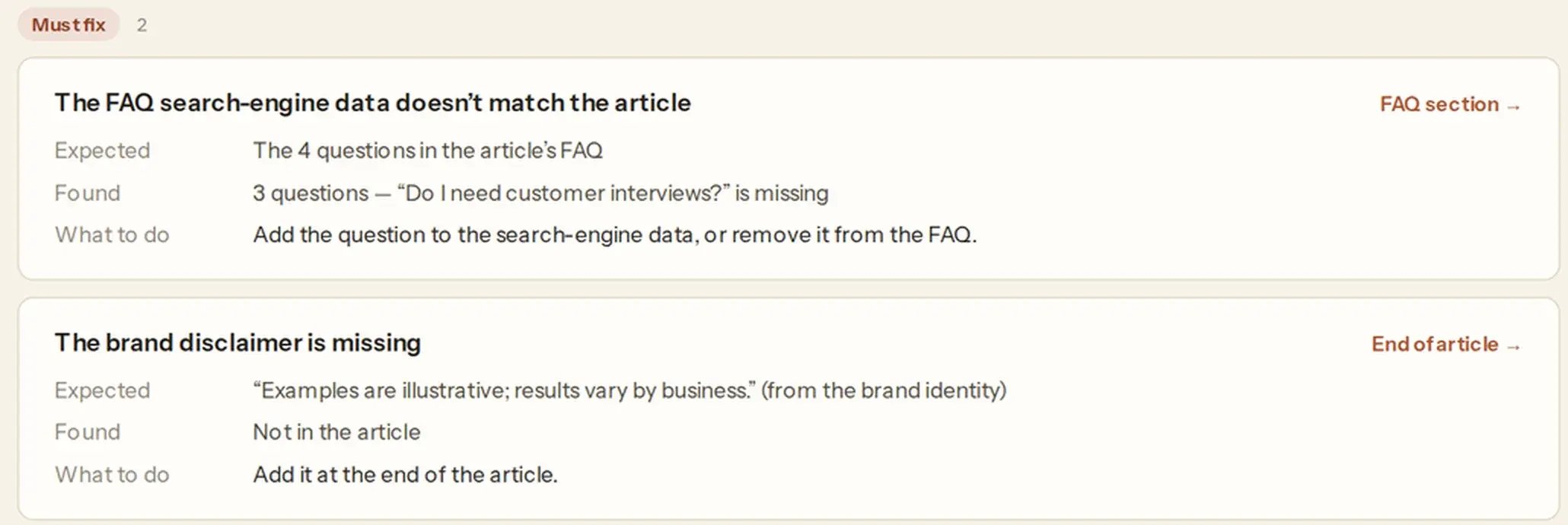
Two must-fix findings in a sample quality report. Real screen, sample data.
Approval stays locked until the must-fix issues are fixed and every flagged passage has a decision, and an approved article is locked, so any change to what it says starts a new version. If you let Mary work on her own, she also adds internal links to your live articles without a new version. Marketing Mary publishes to HubSpot from its first release, and WordPress follows shortly after. Data is hosted in the UK (London). See the whole sequence on how Marketing Mary works, or follow one article on the articles page.
You can automate most of it: research, drafting, images, formatting, quality checks and the publishing step itself. The decision to publish shouldn't be automated. A named person should review the claims and approve each piece, because the business is accountable for what goes out under its name.
No, not for being AI-generated. Google says appropriate use of AI or automation is not against its guidelines. Using automation to produce content mainly to manipulate rankings is against its spam policies, and Google advises fact-checking and reviewing all AI-generated content before publishing.
Start with a claims-and-evidence table: every checkable claim, its source and a status. Add rule checks for headings, brand voice, structured data that matches the page, and promises or absence claims. Have the check list anything it couldn't run, and send the report to a named approver.
Approval should never be fully automated. Quotes shouldn't be written by a model, and promises about results or claims that something doesn't exist need a person's decision. Choosing which questions to answer also needs someone who knows the business and its buyers.
Treat every change as a new version. Lock the approved article, create a new version for the edit, run the quality check again and get a fresh approval before it republishes. That keeps a clear record of which version a person actually signed off.
No, apart from internal links. Every article goes through the quality check and waits for a named person to approve it against a six-point checklist. If you let Mary work on her own, she also adds internal links to your live articles without a new approval. Marketing Mary publishes to HubSpot from its first release, and WordPress follows shortly after.
See what Mary finds on your website.
Join the early-adopter list and be one of the first to try Mary on your own website.
Plans from Free to Enterprise · pricing to be confirmed
Clwyd Probert
Founder, Marketing Mary
Clwyd Probert is the founder of Marketing Mary, an evidence-first persona intelligence platform for B2B marketing, and CEO of Whitehat, a London-based SEO and inbound marketing agency and HubSpot Diamond Solutions Partner.
Sources, checked against the original documents on Oct 8, 2026
researched Google Search Central, Google Search's guidance on using generative AI content on your website. Updated Oct 1, 2026.
researched Sullivan and Nelson, Google Search's guidance about AI-generated content. Google Search Central Blog, Feb 8, 2023.
researched Google, New ways we’re tackling spammy, low-quality content on Search. Mar 5, 2024, updated Apr 26, 2024.
researched Google Search Central, Creating helpful, reliable, people-first content. Accessed Oct 8.
researched Google Search Central, General structured data guidelines. Accessed Oct 8.
researched Google Search Central, AI features and your website. Accessed Oct 8.
researched NIST AI 600-1, Generative Artificial Intelligence Profile. NIST, July 2024.
researched Walters and Wilder, Fabrication and errors in the bibliographic citations generated by ChatGPT. Scientific Reports 13, 14045, Sep 2023.
researched Magesh et al., Hallucination-free? Assessing the reliability of leading AI legal research tools. Journal of Empirical Legal Studies 22, 2025.
researched McKinsey, The state of AI: How organizations are rewiring to capture value. Mar 12, 2025.
researched Jaźwińska and Chandrasekar, AI search has a citation problem. Tow Center for Digital Journalism, Columbia Journalism Review, Mar 6, 2025.
researched Ahrefs, What percentage of new content is AI-generated?. May 19, 2025.
researched Moffatt v. Air Canada, 2024 BCCRT 149. BC Civil Resolution Tribunal, Feb 14, 2024.
researched Mata v. Avianca, Inc., Opinion and Order on Sanctions. S.D.N.Y., June 22, 2023.
researched FTC Policy Statement Regarding Advertising Substantiation. Federal Trade Commission, 1984.
researched FTC announces final rule banning fake reviews and testimonials. Federal Trade Commission, Aug 14, 2024.
first-party How Marketing Mary researches, checks and approves articles: Marketing Mary's own product documentation and its articles page. Screens show fictional sample data.
 Clwyd Probert: Sep 30, 2026, 8:25:00 PM
An evidence-graded buyer persona is a buyer persona in which every claim carries a label saying where it came from: first-party evidence (the...
 Clwyd Probert: Sep 9, 2026, 11:58:11 PM
Our own Search Console tells this story: impressions up 53% and clicks down 6% in the 28 days to September 6, 2026, compared with the 28 days before,...
 Clwyd Probert: Aug 25, 2026, 10:16:09 AM
You can find HubSpot's credit rates. You can find your monthly allowance. What you cannot easily find is the sentence that connects them — so most...
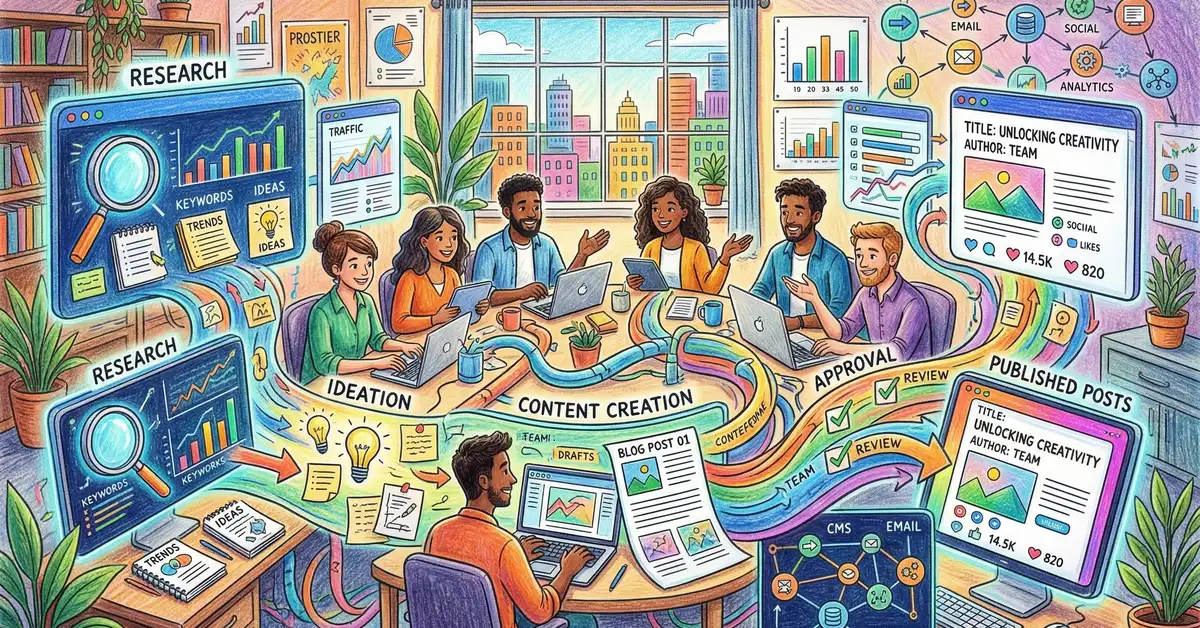 Clwyd Probert : Mar 23, 2026, 12:00:00 PM
Five AI marketing workflows, from brief to reporting, with what to automate in each and where a person should approve.
 Clwyd Probert : Mar 28, 2026, 9:00:00 AM
HubSpot marketing automation explained: what each tier includes, Breeze AI features, common setup mistakes and a step-by-step implementation plan for...
 Clwyd Probert : Mar 25, 2026, 10:00:00 AM
What AI marketing automation is, how it works, and the features to look for: a practical 2026 guide for small B2B marketing teams, with a 4-phase...